2026 Irish Person of the Year: Lynn Mascarelli
By Kathleen Sweeney
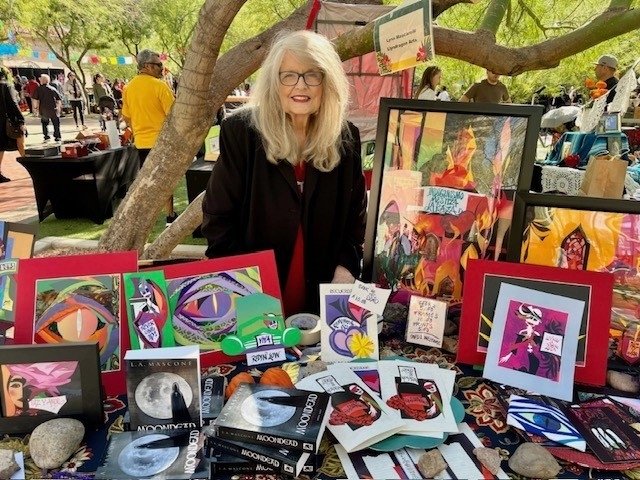
The St. Patrick’s Day Parade and Faire Committee has selected Lynn Mascarelli as its 2026 Irish Person of the Year. Lynn was born in Glen Ridge, New Jersey, where for nearly half her life, she lived with her family, which she describes as having been working-class, with her father having been “a humble, hard-working man who painted houses in the warm season and drove a coal truck in New Jersey’s cold, hard winters.”
Lynn’s mother was a secretary, who died when Lynn was five. “I’ve mourned her my whole life,” Lynn says, “because there was so much that I could have learned from her. I needed her to hold me, and I have felt this way most of my life. It was during World War II. My father had been drafted into the Army, and I rarely saw him until I was seven. There was always a distance between us, especially after he remarried.” Today, her stepbrother, William Herdman, and stepsister, Barbara Herdman Honsberger, still live in New Jersey.
Lynn knew and loved her grandparents. Her paternal grandparents took care of her after her mother died. They loved her and were a good part of her younger life. She describes her maternal grandparents as having been “lovely,” but she saw them only when her mother was alive and took her to visit them in Washington, D.C.
When asked what the most important things that she may have learned from her parents were and how her parents have influenced the person who she is today, Lynn responded that “I was told to be honest and good, which is a good thing. But I learned through a hard childhood that I could not rely on anyone else but myself to do that. That conviction has stayed with me to this present day. I know that it sounds grim, but I think that it has held me up in good times and bad.”
At the very young age of eighteen, Lynn joined the military and left New Jersey for basic training at Lackland Air Force Base in San Antonio, Texas. She was initially assigned to work as a Chaplain’s assistant, assisting the Chaplains of all faiths—priests, rabbis, and ministers. “We had only one altar,” she recalls, “and I had to set it up and arrange it for each religion’s faith gathering.” She was subsequently stationed at Francis E. Warren Air Force Base in Cheyenne, Wyoming; at Scott Air Force Base in Belleville, Illinois; and at Keesler Air Force Base in Biloxi, Mississippi. At Keesler, she was given new work as a newspaper reporter/cartoonist for the United States Air Force Information Services.
Following her time in the service, Lynn attended Seton Hall University in South Orange, New Jersey. She earned a Bachelor of Science degree in Elementary Education and a Master of Arts degree in Urban Education and Policy Studies/Black American Studies. Lynn explains that “there really was such a graduate degree program then. It was the late sixties—the time of Dr. Martin Luther King, Malcom X, and the Black Revolution.” Lynn lived in a very urban part of the state, where she served for a time as a caseworker for the Essex County, New Jersey, Welfare Board. She later turned to teaching in both the public schools and the Diocesan Catholic School District of Newark. She says, “There was real need, and there were riots. I wanted to help kids and people who were hurting.” Later in life, Lynn earned a Master of Arts degree in Theology from the Jesuit University of San Francisco.
In June of 1975, Lynn moved to Arizona “on one of the hottest days of the year,” as she remembers it. Her husband’s family had lived here for some time, and he wanted to be close to them. Lynn continued to teach Art, English, and Theology in the Phoenix Diocesan Catholic High School System—first at Bourgade, then at Seton, and finally at St. Mary’s. In 1992, she moved on to the Phoenix Union High School District, where she taught U.S. Government and History for the final thirteen years of her teaching career, which spanned forty years. When asked what she liked best about her career, Lynn responded, “I was able to use the talents that God gave me to try to make a difference. I’m not sure that I actually did, but I worked at doing so.”
Lynn has been retired for over twenty years. She is now a local artisan and author and the owner of Llyndragon LLC, a Celtic-Sonoran arts and writing studio. She has published The Sacristan Mysteries series, which is set in a fictitious remote Arizona city. Its protagonists, a Belfast-born detective and a nun who is the sacristan of the dark and haunting Cathedral of San Miguel, join forces to solve mysteries that arise in the city and the desert around them. The first two books in the series are called The Moondead and The Tomb Woman. Book three, The Church of Bones, is currently in progress. Lynn’s other creations include small books depicting the words and imagery of ancient Celtic wisdom and the life of Saint Brigid as well as a collection of power point lectures on Celt art history and archaeology that she shares at meetings of the Irish Cultural Center (“ICC”) affiliate, Celt Raven Society. She sometimes also shows her art at other ICC events and at events in the broader community, such as the annual Dia de Los Muertos celebration at St. Mary’s Basilica.
Lynn loves and finds comfort in anything medieval. “There is a mystery in it,” she says. “It was a time of exploration and of building monasteries where all kinds of arts were explored, especially within the scriptoria where books were created, not on a printing press, but by the hand craft of scribes who illuminated and calligraphied parchment. It was a time when a kind of mystical art and architecture would begin that would later flourish during the Renaissance. Women like Brid of Kildare were finding themselves and beginning to stand on their own in the early Dark Ages. But these were hard times.”
Lynn’s family also lives in Phoenix. Her son, Christopher Mascarelli, is a graphic designer and a professional actor in the Valley. His wife, Maren Maclean Mascarelli, is well known in theater circles as an actor, director, and adjunct professor. She is also of Scottish descent and is a proud member of the Clan of Maclean. Their two children, Scotlyn, who is twenty-two, and Siena, who is eighteen, are very special to their grandmother Lynn.
Irish culture was not a huge part of Lynn’s life in her youth and early adulthood, although one of her high school teachers was an Irish nun who became unforgettable and who drew her into all things Gaelic. With respect to her Irish ancestry, she knows only what she has learned through an old family tree and the “1-2-3 and Me” genealogy group, which claims that she is seventy-nine percent British, Welsh, and Irish. Her mother was Welsh and was a Williams, whose roots reach back to the late seventeen hundreds and the Isle of Anglesey. Her paternal grandfather, Arthur Herdman, was a publican who owned the Cedar Grove Inn in Cedar Grove, New Jersey. His DNA came from both sides of the English Channel and Ireland. Lynn’s maiden name was Herdman, which was an occupational surname back in the day, but she has found the name on genealogy maps of Ireland clustered around Dublin and down Ireland’s east coast.
But the name Herdman is also the name of a town on the border of New York State and Canada, where Lynn discovered that a number of Herdmans came to the United States via the St. Lawrence River rather than through Ellis Island. Many of them settled in what is known as Sleepy Hollow in New York State as well. Lynn is also aware of the many Herdmans who were shoemakers and cobblers and who settled in Orange, East Orange, and South Orange, New Jersey, in the late eighteen hundreds and into the twentieth century. Lynn would later live and teach in and around these communities before moving to Arizona.
One day in 1984, Lynn was sitting in her classroom on her lunch break when a young man came into her classroom looking concerned. “I asked him to sit,” she says, “and he told me that his da’—yes, his da’—had just left for a fact-finding mission in Northern Ireland.” Lynn was not familiar with the history of Northern Ireland then, but everything changed that day. A student had in passing set her on a course to learn more, and she became obsessed with learning everything. She began to engage more with the Irish community here in Phoenix, read everything that she could, and joined an online group of people, many of whom were living in or were from Northern Ireland. She quickly learned about the struggle between the Unionists, who wanted Northern Ireland to remain part of England, and the Republicans, who wanted to unite Northern Ireland with the Republic of Ireland. She also learned about Bobby Sands and the other prisoners who had held a hunger strike in the Maze prison in 1981 that attracted international attention and that marked a turning point in “the Troubles,” as the conflict had come to be called.
In the summer of 2003, before Lynn’s last year of teaching, she matriculated in a course and attended a symposium on the culture of Northern Ireland for teachers and college students from all over the world at Queen’s University in Belfast. “It was one of the highlights of my life,” she says. She spent any extra time that she had on Falls Road, which seemed to have been a center of Irish republicanism then. She attended events and hired Black Taxis to take her everywhere. The taxis had provided public transportation during the Troubles in areas where public buses had been shut down or refused to enter. She came to find out that some of her drivers had actually been in prison with Bobby Sands and had stories to tell. But she wanted to know both sides and talked to people on both sides when it was prudent. “And you really had to be prudent,” she recalls. Her professors at Queens had told her to be “prudent and circumspect.”
When Lynn returned from Belfast, she started searching for a connection with “any Irishness in Phoenix.” She found it at the Irish Cultural Center, which was itself in its beginning stages. In 2003, she volunteered to make posters and signs for the Fall Festival at the Center that year. She remembers spelling what she calls “that dear name ‘McMorrow’” wrong—for which she still apologizes—and having to redo it.
She later became a docent when Pat McCrossan had his gift shop and Mary Moriarty had her office in the so-called “cow shed” attached to the Irish Cottage. Patricia Prior, who became the Center’s Executive Director in Lynn’s first years there, invited her to join the Celtic Crafters, a group that was creating all kinds of fantastic stitchery. They gave her their scraps of cloth to make what would become her own framed fabric art. From that point on, she had art tables at many of the Center’s events over the years, and she was honored to be selected Artist of the Month—as was the custom then—throughout the years. She taught Celtic Art History in the Center’s Academy of Irish and Celtic Studies. She was part of the first Ulysses Readers group, which Patricia Prior organized. After Patricia’s duties became more intense, Lynn help to organize the annual James Joyce readings that were held in the Cottage on Bloomsday for many years. “It was a wonderful event,” she recalls. “People even brought their own Ulysses books to follow along with the script that we had created and we held discussions at the end of the readings.” She currently moderates the Celt Raven Society, which is devoted to researching and presenting Celt art history and archaeology. It meets in the Center’s McClelland Library’s Norton Room each month, and it is open to the public.
Lynn remembers and respects the Center’s Founders who made it what it is, although she notes that sadly, many of them have passed on to God and are no longer with us. She especially remembers the wisdom and goodness of the Cunninghams, the Lees, and the O’Briens among others and the early imaginative work of the architect, good Paul Ahern. “The Center has allowed me to associate with some lovely, good people and with all kinds of wonderful characters—ha!” Lynn says. “It’s also been a place to feel at home when I needed it sometimes.” She is grateful to all of those whom she has met in such a lovely location, but she will now be researching her own ancestry much more in the Library’s genealogy center.
Lynn notes that the Center has enabled her to associate with some people who have become very important to her. During the time when the Artist of the Month designation was a tradition inviting an artist to exhibit his or her work in the Great Hall for one month, Lynn met Myles Hassett, “a son of County Cork” and a respected attorney. He bought a very large fabric piece of Lynn’s that was on display, and he has remained interested in her artwork ever since. “I like to say that I have a gallery here in Phoenix that I don’t own,” Lynn says. “It is located in Myles Hassett’s law firm, where he has between fifteen and twenty pieces of my artwork on his walls. He continues to commission new pieces from me. He practices law at the highest level, is a wise man, and has become a dear friend whom I have trusted for years. I’m very grateful for this association and for many other associations as well—particularly for the friendship of Mary Moriarty, who was so supportive about allowing my art to be ‘out there’ during her ICC tenure. Granted, I got scolded a lot, ha! But I wasn’t afraid of her—I just wanted to keep her happy.”
Lynn is looking forward to attending the Parade and the Faire with her close family and friends.